Photo: #15


It's hard to discuss mercurial writer, playwright Yukio Mishima (January 14, 1925 -— November 25, 1970) without the spectre of his demise casting a pall on the dialogue.
From Wikipedia (edited for conciseness):
On November 25, 1970, Mishima and four cohorts visited the commandant of the Ichigaya Camp - the Tokyo headquarters of the Eastern Command of Japan's Self-Defense Forces. Once inside, they proceeded to barricade the office and tied the commandant to his chair. With a prepared manifesto and banner listing their demands, Mishima stepped onto the balcony to address thegathered soldiers below. His speech was intended to inspire them to stage a coup d'etat and restore the Emperor to his rightful place. He succeeded only in irritating them and was mocked and jeered. As he was unable to make himself heard, he finished his planned speech after only a few minutes. He stepped back into the commandant's office and committed seppuku (ritual suicide).
Now that's an exit.
The full story on Mishima is complex and troubling: a sheltered child raised by a temperamental and artistocratic grandmother (who came from a samurai bloodline), only to return at the age of 12 to his parents. His father was a strict disciplinarian and it is suggested that his relationship with his mother bordered on incestuous.
Writing in secret (so that his father wouldn't find out), Mishima's stories focused on recurring themes of death, obsession, dishonour, and the consequences of unexamined emotions.
Mishima was gay, yet paradoxically (considering the society he inhabited) became obsessed with martial arts and militaristic self-discipline.
His critically-praised work includes the semi-autobiographical Confessions of a Mask and the fiction tetralogy Sea of Fertility. Mishima submitted the final draft of the fourth novel in the series, The Decay of the Angel, to his publisher on the same fateful day he and his colleagues would drive to the military school.

Having read a selection of his work (Confessions, Sailor, and the short story collection Acts of Wisdom), it's clear that Mishima was an individual tortured by his own demons. One may argue he was born into a society which could never support his dynamic shape. His narrative style is poetic and sensual, though often critical of society and soaked with the tragedy of characters misdirected by love and self-discipline. Beautiful though they are, Mishima's stories are often dark and painful. It's for this reason I would be lying if I said I read his work regularly - though I wouldn't hesitate to describe them as rewarding (if not seminal) works for the fiction reader.
If you're curious about Yukio Mishima - and while I would not call it a definitive example - you may want to check out Mishima: A Life in Four Chapters, a film by Paul Schrader (who wrote Taxi Driver). It blends the story of his untimely death with lusciously visual renderings of some of his short stories.
You have to lose
You have to learn how to die
if you want to want to be alive
- Wilco, "War on War"
I had this song going through my head all weekend, the last weekend of my vacation (and sorry for the lack of updates recently). It's probably one of the best songs I've heard in such a very long time. Like Guided By Voices' "Game of Pricks" and Roxy Music's "Mother of Pearl", it's one of those tracks that I have to listen to again and again and again because somewhere in it is a phenomenal beauty that is as elusive as it is sublime.
It's uplifting but with a hurt core - the capitulation that "you have to learn how to die if you [...] want to be alive". I've been coming to terms with this theme over the last while, admittedly transposing it onto something it probably was never intended to be 1.
After four-and-a-half years, I gave notice today that I was leaving my full-time job. Steady pay, benefits, desk - gone, so that I can work as a freelancer.

Without going into sordid detail, I felt the need/want/desire to leave, but for the longest time I was paralyzed with fear about going freelance. This in spite of the fact I often came home despondant...that it was harder to write/revise my fiction when the best chunk of the day was spent in a chaotic environment...that with every passing week I felt I was missing out on a different yet possible life.
I don't believe there is any more effective way to conquer a fear than doing so knowing that failure is also a possibility. You have to float on a raft to get over your fear of water. The chance of failure must be present, otherwise all you can achieve is a virtual success - in which case you might as well play a video game simulation of it rather than tackle the real thing. Playing blackjack against a computer will allow you to learn about the rules of blackjack (and probability mathematics) - it will not prepare you at all for a table full of experienced players in Vegas staring at you like a idiot because you've never had to deal with intimidation.
In other words, you must be prepared for the chance that, no, things may not go well. That is, after all, the way life works: at the dawn of time mankind signed no such contract which promised we would die unbruised. So, if an amount failure is inevitable (whether it be due to chance or fault) the best you can do is inform yourself as much as possible before taking any big leaps. The rest is going to happen whether you intended it to happen or not.
I needed more flexibility in my life. More freedom to do what I want without collaborating with a single entity that could never realistically put my needs before its own. Now the responsibility is mine: I can't blame anyone anymore if things don't pan out. However, I can tell you, in facing the unknown there is something very, very liberating.
 Hello all,
I've passed the 50-post mark without much fanfare (I'm saving it for the 100th), and I don't see Imaginary Magnitude hitting the 10,000 visitor-mark for another couple of months - however I thought I'd just say hello and thanks to all the people who pass-through, whether via BlogMad, StumbleUpon, or any of the myriad ways people find their way here.
This site gets visitors from across the globe - here's the latest 100-visitor sample: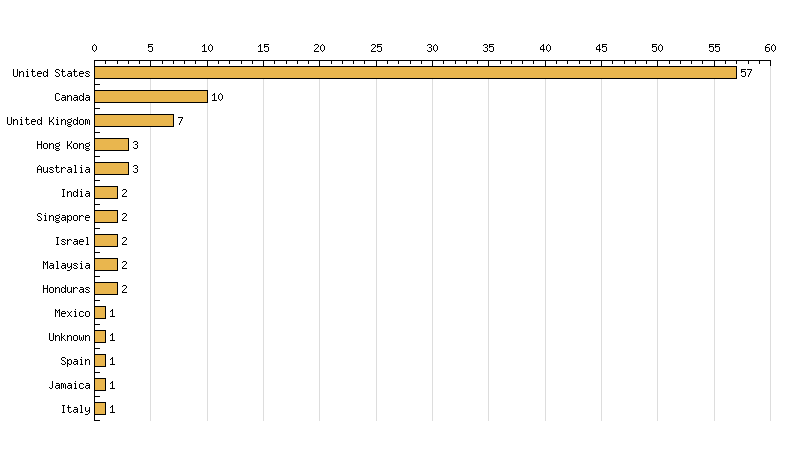
Sure, a little Ameri-centric, but every visitor counts.
What surprises/impresses me in particular is the number of people who spend more than an hour actually reading the articles I write (either that or staring at the pretty photos...or maybe they just fell asleep and didn't log-off). From the same sampling, here's the breakdown:
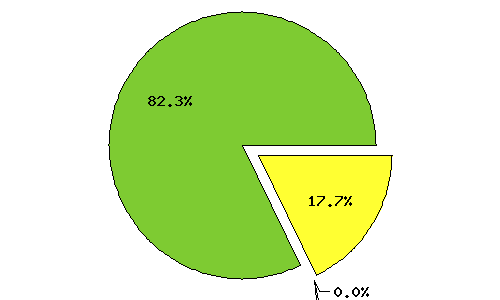
That's 17.7% of people spending over an hour here.
On this note, if anyone has any suggestions, please let me know. More photos? More essays? More article/book reviews? Less? Go home? Your blog sucks? Let me know.
[from the I Wanted To Write About This Article a Month Ago Department]:
Jaron Lanier is a contributor and member of edge.org 1 (which I have listed in my sidebar links). Specifically, he offers his perspective on the evolution of technology and the internet and is credited as a "computer scientist and digital visionary". In an essay posted May 30th, Digital Maoism: The Hazards of the New Online Collectivism, he tackles the rise of aggregator/meta-centric portals such as Wikipedia (which I also have listed in my sidebar links), where individual contribution he argues (and to this extent, responsibility) is obscured by an emphasis on a hive mind approach.
Lanier starts, appropriately enough, by sharing the fact that his Wikipedia entry refers to him as a film director, which is truthful only to the extent that he made one film, a decade and a half earlier. "Every time my Wikipedia entry is corrected," he begins, "within a day I'm turned into a film director again. I can think of no more suitable punishment than making these determined Wikipedia goblins actually watch my one small old movie."
And with this he sets his target. It isn't, he insists, Wikipedia itself:
"No, the problem is in the way the Wikipedia has come to be regarded and used; how it's been elevated to such importance so quickly. And that is part of the larger pattern of the appeal of a new online collectivism that is nothing less than a resurgence of the idea that the collective is all-wise, that it is desirable to have influence concentrated in a bottleneck that can channel the collective with the most verity and force. This is different from representative democracy, or meritocracy. This idea has had dreadful consequences when thrust upon us from the extreme Right or the extreme Left in various historical periods. The fact that it's now being re-introduced today by prominent technologists and futurists, people who in many cases I know and like, doesn't make it any less dangerous."
Lanier's strongest point, as I see it, is his contention that the collectivist, hive-driven format of sites such as Wikipedia (and extended in his essay to meta-meta-meta aggregators such as Digg and Reddit) continue a troubling trend toward aggregated, impersonally edited content over... well, content curated and written by identifiable humans.
"The race began innocently enough with the notion of creating directories of online destinations, such as the early incarnations of Yahoo. Then came AltaVista, where one could search using an inverted database of the content of the whole Web. Then came Google, which added page rank algorithms. Then came the blogs, which varied greatly in terms of quality and importance. This lead to Meta-blogs such as Boing Boing, run by identified humans, which served to aggregate blogs. In all of these formulations, real people were still in charge. An individual or individuals were presenting a personality and taking responsibility.
[...]
"In the last year or two the trend has been to remove the scent of people, so as to come as close as possible to simulating the appearance of content emerging out of the Web as if it were speaking to us as a supernatural oracle. This is where the use of the Internet crosses the line into delusion."
Lanier's line of query unfolds to include the observation that the "meta" is now more popular and, in respect to Google News, more profitable than traditional media (newspapers in particular), yet no one standing next to the microphone is able to articulate the fact that popularity contests do not historically vet the best, but rather, what the collective believes is safest. And of course, nobody seems to want to say that the collective is just as culpable - in some ways more powerfully culpable - as individuals.
I highly suggest anyone interested in the social internet, its architecture and direction, give this essay a good read. Lanier's observations move from the immediate suspects above to commentary on analogous movements, such as Linux 2, the "open" software movement, and the ever-ubiquitous MySpace. In many respects, it's about time somebody spoke eloquently about the collapse of the human face behind these efficient portals.
However, I do have some issues. For one thing, the tangents never really weave into a comprehensive whole, making it feel much too cumbersome (and a page too long) to concisely support Lanier's provocative thesis. There are many arguments using the financial marketplace as a comparison tool which, although in theory an applicable analogy, is probably the last example I would use if I were arguing for a more humanistic approach. In fact, for someone arguing for this approach, Lanier's language sometimes bares the same technocratic opaqueness which I would argue obscures a better understanding of the debate.
For example, leading to his summary:"Empowering the collective does not empower individuals — just the reverse is true. There can be useful feedback loops set up between individuals and the hive mind, but the hive mind is too chaotic to be fed back into itself."
I realise the term "feedback loop" is an applicable simile when discussing communication, but it's disconcerting when a term normally applied to specialty occupations - namely, software programming and audio engineering - should somehow become the standard upon which we seek to inspire a better world. Is this not, to some extent, asking a less-predictable society to be like a more-predictable tool?
Please read the essay for yourself and feel free to share your feedback in the comments section.
Please note: there is a discourse on the essay on the edge.org site here.

I will be going to Jacksonville, Florida in August. If anyone can suggest anything reasonably cool to do while I'm visiting (art, life, vibe sorta stuff) please let me know.

I've been there before, so I already have some impressions.


Any guidance is appreciated.

Eric Bogosian wrote in 1995 :
It's a truism to say that movies, TV and canned music are all dead media. In fact, they are machine-made. Might as well have electrodes sunk into my gray matter as a pair of headphones and some house music. Now, don't get me wrong. I like a blasting boom-box as much as I love jerking off and I'd be sad if I couldn't slink into a refrigerated movie theater in the middle of a hot, stinking New York afternoon and sedate my self with greasey [sic] salted corn while watching illuminated photos of people killing each other.
But it's all dead. Which is to say, un-unique. Every one the same as the other. The movie (or TV show or record) is the same whether I'm there or not. That's why it's like porno as opposed to sex. Good theater is like having sex. It's different depending on who you're with.
I originally read this in a newspaper article, though paraphrased more succinctly: theatre is like sex while film is like masturbation.
So as to not give the impression that I've withheld a decade's worth of disagreement, this is not the first time a theatre actor has publicly pissed on filmmaking (in general, no less) whilst implying theatre as sacrosanct. More recently, a local theatre actor with a sizeable list of TV/film roles had done the same in a local weekly. And every time someone takes this approach it's hard not to view them as precious ideologues.
Arguments like this are easy to make, especially when you opt to side-step the reality of that which you are criticizing. To be fair (some may say too fair), I like to think Bogosian was championing theatre (specifically New York's scene) as opposed to condemning film, seeing as he was distressed at the brain-drain occurring at the time (and I'm sure continuing to this day).
The truth is that there is nothing inherently masturbatory about film or filmmaking, or at the very least the threshold is no greater than in - dare I say it - theatre. If I may borrow Bogosian's turn of phrase, it's a truism that there is more to filmmaking than the inflated mediocrity we see passing through our cinemas on their way to the DVD shelf. How difficult would it be for anyone to use the same argument about theatre: Mama Mia, anyone? Is it fair to base an argument about theatre on Tarzan? Truth is, every artistic medium has its share of sequined fluff and it is patently unfair to point to the worst (or, in the case of LA, the home of the worst) for validation. It's an argument which ignores the power (abetted, I argue, by actors also) of such a wide array and long history of great filmmaking that tallying a list (as I've attempted for the last 20 minutes) seems as asinine as Bogosian's comment.
Every artist works with the bells of his pursuit's downfall ringing in the background. This is part of the very thing which pushes artists to do their best work: namely, being pissed-off (or, depending upon your local caste system, "outraged"). Being pissed-off gives us the plays, films, and yes - television - we as a society need to have around us (if not to watch). So, if Bogosian was simply sounding a pro-theatre rallying cry, I can understand. What I can't understand is when reasonably intelligent people denigrate perfectly analogous pursuits for sake of expressing their petty love of another.


 Posts
All Comments