Book Review: Moby Dick, by Herman Melville
You may be asking yourself: "Moby Dick, eh? Not exactly current fiction, Mr. Blogger."
No, it's not. But if it's good, it should be read. This is a good book. It's a classic 1.
Published in 1851 (happy 155th anniversary!), Moby Dick is an originally rendered tale told by Ishmael (whose last name we never know...in fact, we never learn the full names of any of the characters), a young veteran of the merchant marines who longs to find work (and a new life) on a whaling vessel. Naturally, his interests take him to Nantucket, Massachusetts, where he finds a ship waiting to sail - the Pequod. With the help of an exotic tattooed harpooner, Queequeg, he hops aboard willingly, despite the warnings of a street prophet regarding the Pequod's captain - Ahab.
Once aboard and sailing, the narrative eventually inverts from the wide-eyed first-person accounts of the opening to third-person, peppered with Ishmael's astute observations - it's clear from this narrative transformation that Ishmael himself becomes subsumed by his experiences at sea aboard the Pequod, obsessed with the details of her crew and captain, and with the object of their profession: whaling.
The problem begins soon after setting sail; Ahab, a remarkably bleak and forceful figure, announces that - contrary to their practical purpose - they have an ultimate quest ahead: to find and kill the White Whale, Moby Dick. This single whale, we learn, is the burning flame which drives the Pequod's captain to "monomaniacal" ends, Moby Dick having claimed Ahab's leg (and perhaps a part of his soul) on a previous voyage.
As the novel proceeds, the reader is consumed by the everyday life of a whaler at sea: the sometimes savage danger, the simple yet sublime pleasures, and the technologies of the day. Everyone from the sail-mast lookout to the blacksmith, from the cook to the boatsmen who trawl for prey - whales, and most importantly, their precious oil - are drawn in colourful detail. Readers expecting a fast-moving plot line should note that Moby Dick takes great pains to paint the seafarer's life, specifically the dying years of the whaling industry (at least as it existed in its heyday); as such the novel has its peaks and valleys as regards pacing. I refuse to take the "this is an old book so you have to disregard its old style" stance - though it's a masterpiece, its strengths will only be rewarding to those with a little patience.
Moby Dick is probably one of the best-written novels I've read. Melville is a writer's writer; he loves language and is very particular about how he describes the life of his characters without it becoming an academic exercise, nor are the allegorical elements cryptically depicted so as to make reading it in a non-allegorical frame of mind impossible. Take any of Ahab's monologues and read it aloud: you will instantly notice the cadence and perfect shape of the sentences - it's like hearing Shakespeare. The book is rife with symbolism: the ship is the world, the crew its people. Moby Dick itself becomes a symbol of the capricious result of the burgeoning 20th-century-man's fateful need to conquer nature.
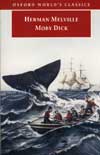
I would like to point out that I read the paperback edition, published by Oxford University Press (pictured above). I mention this in particular for two reasons: it's cheap (500+ pages = $10!), and it comes with a handy reference guide at the back to clarify any directly symbolic (Biblical or simply antiquarian) references in the text. Also, there is an Introduction (written by Tony Tanner) which, after you've read the novel 2, will give you some insight into some of the mainstream analyses of the book. There is also a set of letters Melville wrote to Nathaniel Hawthorne (to whom the novel was dedicated) at the back of this edition - can't say there's anything relevatory there, other than the fact that Melville clearly idolised Hawthorne.
Moby Dick is available for sale at a fine independent bookstore near you and online at...Powell's, Amazon, Chapters, and others. Published by Oxford University Press (ISBN: 0192833855)
1. I don't mean "It's a classic." in the sense that, because everyone calls certain books "classics" that they must always be superior. Some "classics" do not age well. This is not one of those.
2. This is my guide to reading "classic" books: by all means avoid anything written by someone other than the original author until after you've read the book, whether it be an introduction, a foreword, a preface, what have you. Most introductions are academic in nature and worse, full of spoilers. Stanislaw Lem wrote a book, inspired by his distaste for these after-the-fact literary addons. It's called Imaginary Magnitude.


 Posts


